Bitcoin exchange balances are one of the most commonly referenced on-chain metrics, yet also one of the most frequently misunderstood. At a basic level, this metric tracks how much Bitcoin is held on centralized exchanges. At a structural level, it offers insight into liquidity, potential sell pressure, and changes in holder behavior.
This article explains what exchange balances measure, how to interpret them correctly, and what they reveal about market structure when viewed over meaningful time horizons.
What Are Bitcoin Exchange Balances?
Exchange balances represent the total amount of Bitcoin stored in wallets controlled by centralized exchanges. These wallets are typically used to facilitate trading, custody, and internal liquidity management.
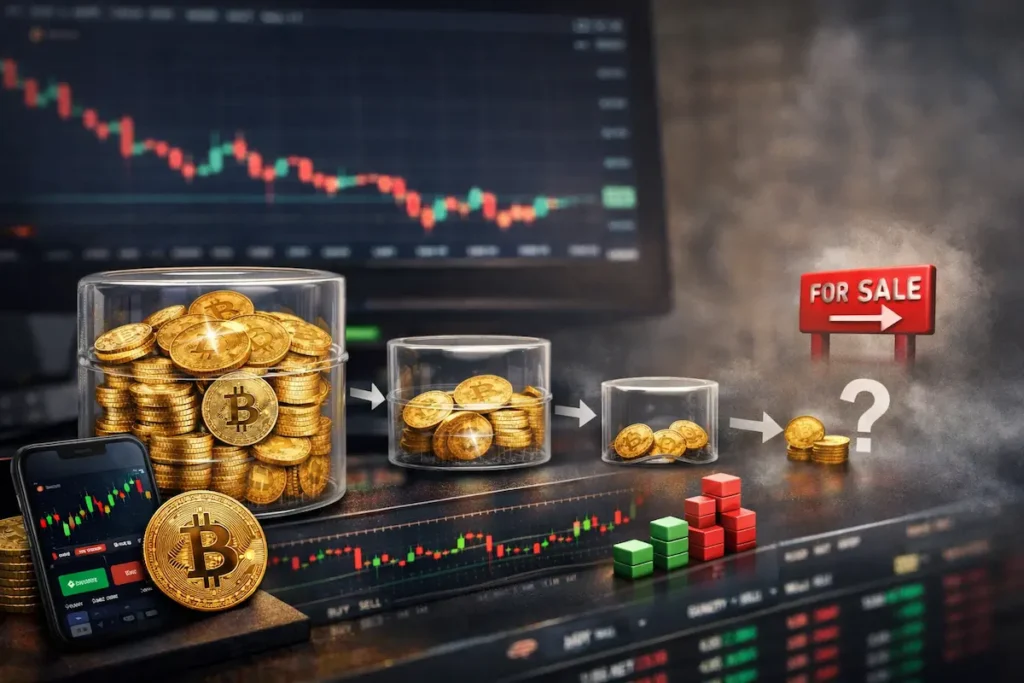
Because most spot selling occurs on exchanges, exchange balances are often used as a proxy for the amount of Bitcoin readily available for sale.
However, this proxy is imperfect and requires context.
Why Exchange Balances Matter
The importance of exchange balances comes from their relationship with liquidity.
In simple terms:
- More Bitcoin on exchanges → higher potential liquidity
- Less Bitcoin on exchanges → lower immediate sell availability
Over long periods, changes in exchange balances can reflect shifts in market behavior, particularly the balance between self-custody and active trading.
Interpreting Rising Exchange Balances
An increase in exchange balances generally indicates that Bitcoin is moving from private wallets to trading venues.
This can occur for several reasons:
- Holders preparing to sell
- Increased trading activity
- Changes in custody preferences
- Institutional inflows using exchanges as intermediaries
Structural Interpretation
Sustained increases in exchange balances often coincide with periods of distribution, where supply becomes more liquid and sensitive to price movements.
However, short-term spikes should not be overinterpreted. Context is essential.
Interpreting Declining Exchange Balances
Declining exchange balances suggest that Bitcoin is being withdrawn from exchanges into private wallets.
This behavior is often associated with:
- Long-term holding
- Reduced selling intent
- Increased emphasis on self-custody
Structural Interpretation
Over long timeframes, persistent declines in exchange balances tend to align with accumulation phases, where supply becomes increasingly illiquid.
This reduces immediate sell pressure and can contribute to market resilience.
Common Misinterpretations
“Lower Exchange Balances Mean Price Will Go Up”
This is a classic mistake. While reduced liquid supply can support price over time, it does not guarantee upward movement.
Liquidity conditions, demand, leverage, and macro factors all influence outcomes.
Ignoring Custody Changes
Not all movements reflect market intent. Regulatory changes, exchange policies, or custody migrations can distort the data.
Exchange balance analysis should always be trend-based, not event-based.
Exchange Balances and Market Cycles
Exchange balances behave differently across market phases:
- Accumulation phases: gradual outflows from exchanges
- Expansion phases: mixed behavior as demand absorbs supply
- Distribution phases: rising balances as holders prepare to sell
- Late-cycle stress: sharp inflows during volatility
Understanding where the market sits in the cycle is essential for interpretation.
Exchange Balances vs Other On-Chain Metrics
Exchange balances are most effective when combined with other metrics, such as:
- Long-term vs short-term holder supply
- Realized cap trends
- Transaction volume
- Derivatives leverage data
Isolated analysis increases the risk of false conclusions.
What Exchange Balances Do Not Show
Exchange balances do not capture:
- Off-exchange OTC activity
- Derivatives positioning
- Leverage exposure
- Macro liquidity conditions
They describe availability, not intent.
How Capitrox Uses Exchange Balance Data
At Capitrox, exchange balances are used to assess:
- Structural liquidity conditions
- Changes in holder behavior
- Potential shifts in market sensitivity
They are not used as standalone signals or timing tools.
Conclusion
Bitcoin exchange balances provide valuable insight into the liquidity structure of the market, but only when interpreted with discipline and context. Trends matter more than absolute values, and structure matters more than short-term movements.
As part of a broader on-chain framework, exchange balances help explain how supply moves between long-term storage and active trading environments.
This article builds directly on the On-Chain Data pillar and serves as the foundation for deeper analysis of Bitcoin liquidity dynamics.