The Market Value to Realized Value ratio, commonly known as MVRV, is one of the most widely referenced Bitcoin on-chain metrics. It is also one of the most frequently misunderstood. Often treated as a simple “overvalued or undervalued” indicator, MVRV is far more useful when interpreted as a structural measure of market positioning and aggregate profitability.
This article explains what MVRV measures, how it should be interpreted, and why it matters for understanding Bitcoin market structure rather than for short-term price timing.
What MVRV Measures
MVRV compares two different ways of valuing the Bitcoin network in order to understand how current prices relate to historical capital allocation. On one side is market value, which represents the current Bitcoin price multiplied by the circulating supply and reflects how the market values the network at this moment. On the other side is realized value, which estimates Bitcoin’s value based on the price at which each individual coin last moved on-chain, effectively anchoring valuation to actual transaction history.
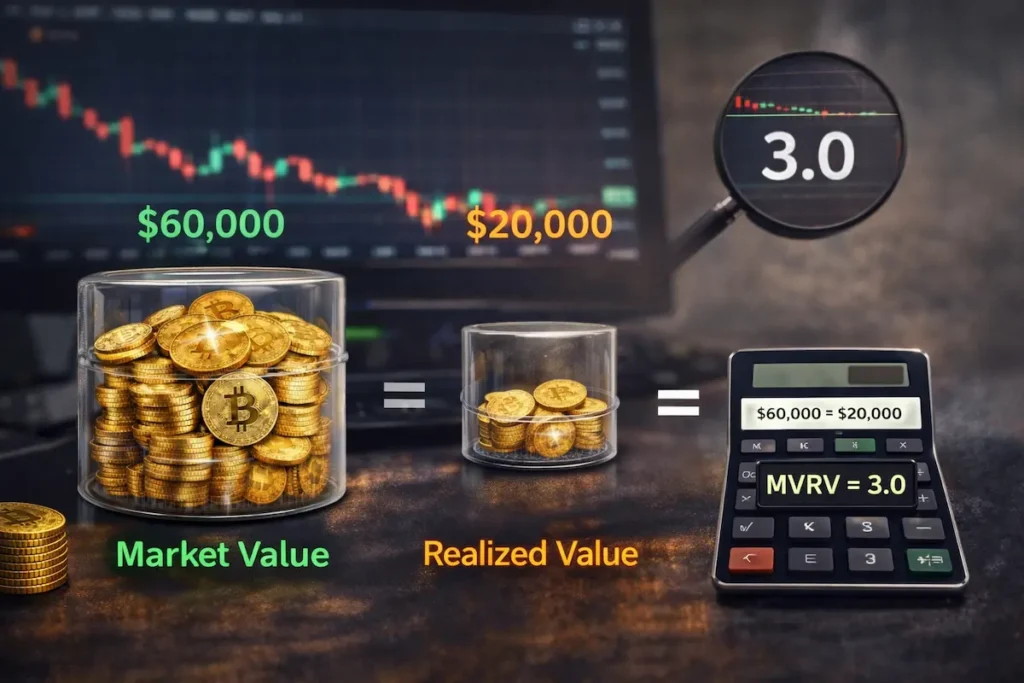
By comparing these two values, MVRV captures the aggregate unrealized profit or loss held by market participants. In simple terms, it shows how far current prices have moved away from the average cost basis of the network, providing insight into whether the market is broadly profitable or under financial stress.
Why Realized Value Matters
Traditional market capitalization assumes that all coins are worth the current market price, regardless of when they were acquired. This assumption creates distortions because, in reality, most coins were bought at much lower or much higher prices than today’s value.
Realized value corrects this distortion by assigning each coin the price of its last on-chain transaction. This approach produces a more accurate representation of the market’s collective cost basis, highlights how much embedded profit or loss exists within the system, and reveals how long-term holders are positioned. MVRV becomes meaningful precisely because it links present valuation to the historical flow of capital, rather than relying solely on spot price.
Interpreting High MVRV Values
When MVRV is high, Bitcoin’s market value significantly exceeds its realized value. This indicates that a substantial portion of the circulating supply is held at an unrealized profit, meaning many participants could sell at favorable prices.
From a structural perspective, high MVRV environments are often associated with elevated optimism, greater sensitivity to negative shocks, and stronger incentives for profit-taking. Importantly, a high MVRV does not mean that price must immediately decline. Instead, it signals that the market is profit-heavy, which increases the potential for selling pressure if sentiment shifts or external conditions worsen.
Interpreting Low MVRV Values
Low MVRV values indicate that market value is close to, or even below, realized value. In these situations, much of the supply is held at little profit or at a loss, reducing the incentive to sell.
Structurally, low MVRV environments tend to coincide with reduced speculative activity, dominance by long-term holders, and lower sell pressure driven by profit-taking. These conditions often align with accumulation phases, although they are also characterized by uncertainty and low confidence, as prices typically lack strong upward momentum.
MVRV as a Structural Metric, Not a Signal
One of the most common mistakes is treating MVRV as a precise timing indicator. MVRV does not provide entry signals, exit signals, or exact valuation levels. Its value lies elsewhere.
Instead, MVRV offers contextual insight. It helps determine whether the market is broadly profitable or stressed, whether holders are more likely to defend positions or exit them, and how sensitive the market may be to volatility. Used in this way, MVRV enhances structural understanding rather than encouraging short-term prediction.
MVRV Across Market Cycles
MVRV behaves differently depending on the phase of the market cycle, which is why context is essential.
During accumulation phases, MVRV tends to remain low as unrealized losses are common and long-term holders dominate the supply. Market behavior in these periods is driven more by conviction than by speculation, with participants willing to hold despite limited price appreciation.
As the market enters expansion phases and prices rise, MVRV increases alongside growing unrealized profits. Sensitivity to volatility also increases, as participants become more reactive to external shocks once profits accumulate.
In late-cycle and distribution phases, MVRV can reach extreme levels. Profit-taking pressure intensifies, and even small negative catalysts can trigger disproportionate reactions. Understanding MVRV in these conditions helps explain why markets can become fragile even when sentiment appears positive.
Common Misinterpretations of MVRV
A frequent error is using fixed MVRV thresholds as universal buy or sell signals. Historical ranges evolve as the market matures, liquidity changes, and the composition of participants shifts. As a result, MVRV must always be interpreted relative to market structure, liquidity conditions, leverage, and the broader macro environment.
Another common mistake is ignoring supply distribution. MVRV reflects aggregate conditions, not how profits and losses are distributed among different holder cohorts. A high MVRV driven by long-term holders has very different implications than one driven by short-term speculative activity. Combining MVRV with holder-based metrics improves interpretation.
Overemphasizing short-term fluctuations is also problematic. Short-term changes in MVRV often reflect price volatility rather than meaningful shifts in market structure. Structural analysis requires patience and longer time horizons.
MVRV and Market Fragility
One of MVRV’s most valuable contributions is its relationship to market fragility. When unrealized profits are high, participants are more inclined to sell into strength, leverage tends to increase, and volatility becomes more impactful.
In these environments, risk becomes asymmetric, with downside reactions often sharper than upside extensions. This is why MVRV is particularly useful within a risk-first analytical framework.
Integrating MVRV with Other Metrics
At Capitrox, MVRV is not analyzed in isolation. It is combined with exchange balance trends, long-term versus short-term holder supply data, realized capitalization dynamics, and liquidity and leverage indicators. This integrated approach helps avoid simplistic conclusions and supports consistent analysis across different market environments.
What MVRV Does Not Capture
MVRV does not account for off-chain derivatives exposure, macro liquidity conditions, stablecoin flows, or external shocks. It explains valuation relative to cost basis, but it does not describe the full complexity of market dynamics.
Why MVRV Matters for Market Structure
MVRV provides a bridge between price and behavior. It connects current valuation to historical capital decisions and helps explain why markets react the way they do under stress or euphoria.
Rather than predicting outcomes, MVRV improves understanding of:
- Incentives
- Sensitivity to volatility
- Structural risk
Conclusion
MVRV is one of the most powerful Bitcoin on-chain metrics when used correctly. Its value lies not in signaling tops or bottoms, but in contextualizing market structure through the lens of aggregate profitability.
By revealing how far market value has moved from the network’s cost basis, MVRV helps explain shifts in behavior, risk, and fragility across market cycles.
As part of the broader On-Chain Data framework, MVRV strengthens structural analysis and supports a disciplined, risk-aware understanding of Bitcoin markets.